Showing posts with label Photography. Show all posts

Friday, February 14, 2025

Tress Facing Up

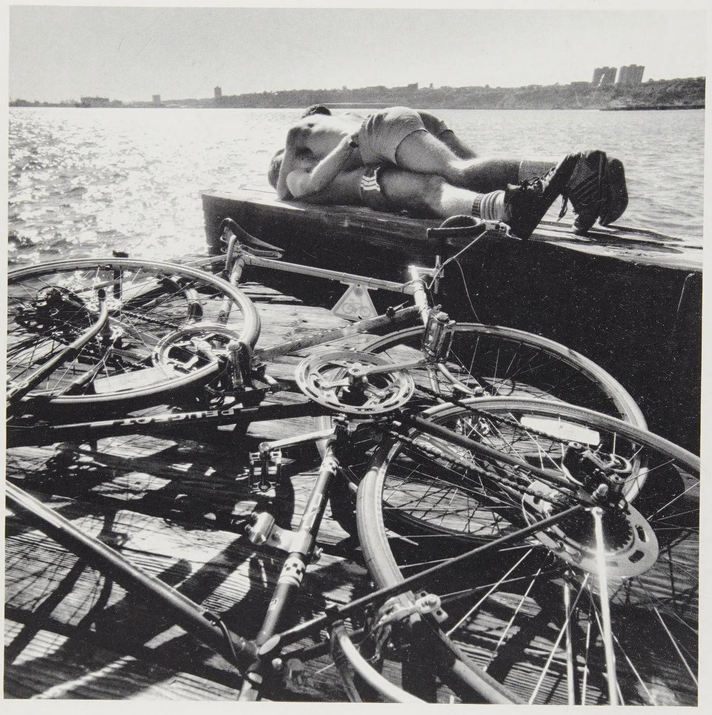
Arthur Tress, Facing Up.


Browsing photography books on a recent rainy day I flipped through a book titled Facing Up by photographer Arthur Tress. I had not heard of him before and had never seen any of his photographs. It was an exciting bit of discovery to find something unfamiliar and immediately love it like in my younger days of looking across a dance floor and finding love at two in the morning.


Tress is a gay male American photographer born in Brooklyn in 1940. His first experience with a camera came at the age of twelve, taking photographs in Coney Island and this is where he began developing his own eye for framing the world in photographs. He studied painting and graduated from Bard before moving to Paris and traveling to Asia, Africa, Mexico and around Europe. Returning to the U.S., he photographed the civil rights movement of the 60s, politics and the Beatles. For the rest of his career he has photographed urban decay, children, life in Appalachia, male nudes and many other subjects that appear in his numerous books and in the collections of museums.

He was a peer and competitor of the more well known Robert Mapplethorpe. Tress' work is much more varied and interesting than Mapplethorpe, who seemed to be obsessed with orchids and sticking objects up his own ass and the asses of others. There is a place for Mapplethorpe, his work and his admirers (count me as one), but even as someone who has stood in museums and admired the stunning work hanging on a wall at close range, I do not get any sense of soaring or delightful inspiration from his work. Mapplethorpe, without fail, leaves me cold. 

Arthur Tress, Facing Up.

Arthur Tress, Facing Up.

Arthur Tress, Facing Up.

By contrast, the male nudes by Tress in Facing Up are playful, fun, imaginative and still retain their eroticism without relying on vulgarity to shock a viewer. I get a sense of humor behind the photographs that dulls the edgy seriousness of the skill that it took to pose the models and shoot them. The intimacy between the eye behind the camera and subject feels natural.

Arthur Tress, Facing Up.


Arthur Tress, Facing Up.

Arthur Tress, Facing Up.

The photos in this book were shot in the late 1970s. Tress lived on the west side of Manhattan near the abandoned Christopher Street Piers along the Hudson River that have since became infamous in gay history before the AIDS epidemic. The piers were a place where gay men would nude sun bathe, cruise for sex, do drugs, and engage in prostitution among other elicit activities. Among those ruins, artists such as Peter Hujar and David Wojnarowicz would create  their art and find inspiration. It was Tress who introduced Wojnarowicz to the piers. Not in this book, but of note is that Tress also photographed in the cruising grounds of The Rambles in Central Park in the more secretive era of the mid 1960s.

Arthur Tress, Facing Up.


Arthur Tress, Facing Up.

This photograph titled Band-aid Fantasy taken in 1977 is my favorite from the book. There is a tenderness about this photo and the peeling away of the band-aid from the bare leg. There is sexiness too with the long legs of the two males exposed from the short shorts sitting alone together on the stairwell. As with all great photographs it is also an excellent manipulation of light and shadow. Arthur Tress, Facing Up.
 

Facing Up was first published in 1980 and again in 2004. If you can find a copy then grab it. Out of his long career and the accolades that he has received, it appears that his photos of gay life have been the least exhibited and the least appreciated. His photos of gay life deserve more recognition.  Stanford University does host an online collection of seventy of his photographs, including some of the nudes from Facing Up, here titled Gay Fantasies.


There is a recent documentary that has  been made about Arthur Tress titled Arthur Tress: Water's Edge.   Unfortunately, it does not appear to be widely available and I have not seen it.


Further reading about Arthur Tress: an excellent, lengthy interview with him from 1999.


Thursday, July 11, 2024

Without Distortion


In an old mill on a recent day.

I have been browsing the David Wojnarowicz papers at NYU the past few days. The photos contained in it are rather good and revealing too. From time to time I listen to his audio journals, Cross Country, which were recorded in 1989 while he was driving around the Southwest.


The 2020 documentary about Wojnarowicz, Fuck You Faggot Fucker, was excellent. Most of the film is in his own words and voice. I was fearful that the documentary would try to project the current political agendas onto his life and work and other than a couple of instances it did a good job of keeping it in context. I would have hated it if the modern revisionists would have tried to make him into something he was not.

I mention Wojnarowicz in my latest novel, Shadow's Gravity. He comes up in a conversation I have with the character Finn in 1999 along with Warhol and Keith Haring.

Not really related to any of this, but it was necessary for me to delete my Instagram account this weekend. There were numerous unsuccessful hacking attempts over the past several months on it. The attempts were annoying and I decided it was best to eliminate the security risk.


Gang of Four - What We All Want

Sunday, May 28, 2023

Taking Notes and Photos

A rundown town in Georgia. April 2023. Photo by me.


Having left the city of Atlanta in the fall of 2021 and moved to a different part of Georgia, I have easier access to a part of the state that I am largely unfamiliar. This part of the state is more rural and remnants of the past still dot the landscapes in their often decayed states. I am reminded some, but not entirely, of where and when I grew up and still my perspective has changed. I am finding new places to inspire my writing. 


I seem to be constantly snapping photos and making notes of what I see as I travel about in my comings and goings in these areas. The new places are inspiring me to think about ideas for writing that I had not considered before.


This is a photographic tour of some of those places.

March 2023. Photo by me.

March 2023. Photo by me.

March 2023. Photo by me.

April 2023. Photo by me.

April 2023. Photo by me.

April 2023. Photo by me.

April 2023. Photo by me.

May 2023. Photo by me.

May 2023. Photo by me.

May 2023. Photo by me.

May 2023. Photo by me.

May 2023. Photo by me.

May 2023. Photo by me.

May 2023. Photo by me.

May 2023. Photo by me.

May 2023. Photo by me.

May 2023. Photo by me.

None of the places shown here are in Athens, though I spend enough time there, but are instead in the smaller places on the map or not on any map at all. These places make me feel as if I am living in the early 80s music of the Athens band, R.E.M. 


These particular R.E.M. songs are in my head quite often as I wander: Can't Get There From Here, Feeling Gravitys Pull and Gardening At Night.


Two of the songs come from the 1985 album, Fables of the Reconstruction. It is an album that features southern gothic characters and themes. Wikipedia describes the album this way, "Lyrically, the album explores the mythology and landscape of the South..."


I am also drawing inspiration from my favorite photographer, William Eggleston - also a southerner.


In early March I went out to a ghost town that is far from any place, down a long gravel road and along a river. I have not written about that place yet and it is not in the photos shown here.

Monday, May 20, 2019

Attending: Art AIDS America


Photo by me. May 2016


Thursdsay, I made the long and horrific drive from the city up to Kennesaw State University. It had been a couple of decades since I had been on the Kennesaw campus, but the art museum hosted a show to draw me back. 


I went to see the Art AIDS America exhibit at the Zuckerman Museum of Art. I have been to too many shows to count, but never once have I cried until this one. Thankfully, the museum knows how devastating this exhibition is and has provided boxes of tissues on benches. By the end I was ready to run far and away. It is staggering the losses that took place in the 1980s and 90s. I remember that time well growing as a member of Generation X.

If you are looking for big names to see it contains work by Robert Mapplethorpe, Annie Liebovitz , Keith Haring and others.

The show closes on the 22nd, this Sunday. It's also free. This is the kind of show the High Museum would never have the courage  to put on. The next stop on the tour is the Bronx Museum of Arts.

Thursday, November 17, 2016

Dispatch From Abercorn Street

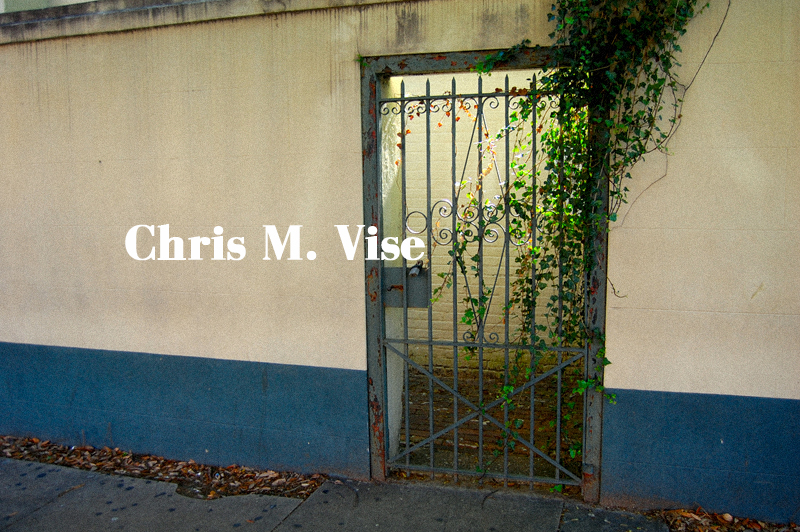
Abercorn Street, Savannah. April 2016. Photo by me.

S

lightly after eleven in the morning in Savannah and I had come from breakfast a couple of blocks away on East Liberty Street. I stood waiting for someone outside the Cathedral of St. John The Baptist. I had been in the vast church before so I waited and watched people pass on the sidewalk. I studied the buildings on this particular block that I had never paid much mind to in my many visits to this city. 


For the historic district, this block was not all that noteworthy so I turned around and caught the light streaming through the gate of a locked courtyard. I liked most that the sunlight was caught in the English Ivy like a spider's web. I took this photo.


Nick Drake. Date and photographer unknown.

Many years ago I became a fan of the English singer/songwriter Nick Drake. I do not remember how or where I came to know his music, but I took an instant liking to it and him. His soft voice, his guitar strumming and the comforting melancholy of his music was so easy for me to relate. His music for me was like sitting next to a fire and watching the sparks drift upwards to the starry night sky or wading through the wet and green countryside on a cold, misty day. I am never more cozy than when I listen to his music.

Behind the music Drake’s life was brief, tragic and he never came to enjoy any measurable success in his twenty-six years. In 1974, when I was only a toddler, Nick swallowed thirty of his antidepressant pills that he had been prescribed and committed suicide at his parent’s estate in the English countryside. He had dealt with depression for much of his life and finally he gave into it. The legend of Nick Drake was partly built on his early death, but the posthumous fame and success is mostly due to the limited catalog of great music that he left us. He is most well known for his song Pink Moon which has been used in commercials, movies and television shows. My favorites songs of his are: Time Has Told Me, Man In A Shed, When The Day Is Done, Fruit Tree, Way To Blue and Riverman.

Photography has meant a lot to me since I was a child. I would not consider myself a great photographer, but sometimes I do get lucky and take something worthy of being considered art. I respect serious photography like I respect a painting. For some time now I have thought that photography as art was dead or on life support. I believe social media, cell phone cameras and everyone taking photos of everything all the time has made everyone think they are a master photographer. People take photos of food now and share them and we are obsessed with selfies (oh, how I hate that word) which means that really they are just self-obsessed. Photography has been devalued and has become a method to indulge our own narcissism. 


The famous photographer William Eggleston of whom I am a great admirer, had an exhibition and book called Democratic Camera. Now that film is no longer necessary and digital photography can be much more cheaply done I believe the camera is more democratic and thus so is photography. What was once a special hobby for enthusiasts or a meaningful way for people to record their family in snapshots for a photo album has become a thumb press away on a smart phone for every meaningless second to be recorded. The world is flooded with images and not photography. 


I was further convinced that photography was dead when I saw this recent ABC story.

Yes, photography died.


Nick Drake, Riverman 

Saturday, September 10, 2016

Dispatch: From A Loft in Castleberry Hill

 
Sam Wagstaff, self-portrait.

Iwas sitting over a coffee on Peters Street in Castleberry Hill. I realized that I needed to finish that biography of Sam Wagstaff to complete my summer reading list. I have not opened the book for a week. I am struggling to maintain interest. Wagstaff's life story should be more interesting, maybe it is the writing? 

Sam Wagstaff & Robert Mapplethorpe
 
He was the lover and sugar daddy of photographer Robert Mapplethorpe, had his own career in the fine art world as a curator and there are his sexual excursions in the 70s and 80s through the New York gay underground. He was friends with Warhol and was the first to hang his work, the Campbell's Soup can, in a museum in 1962. His life should be fascinating, it was in the 2007 documentary Black White + Gray, but it is not in this book. 

*****
 
I see that anarchists marched down Ponce this morning and attacked a Starbucks. The interior was destroyed and customers were injured. It was mayhem as anarchists are want to do. There is a sizeable contingent of them here associated with the ominous sounding The Black Cross. Two were arrested. Here is the Reddit thread about it.

*****

George Plimpton

The Falcons start their season tomorrow and that excites me. Yes, it is okay to like football. You do not have to be a cretin to like the game, even George Plimpton liked football and he was not exactly a dullard.

*****


And now I sit on Peters Street in Castleberry Hill, where in the late 90s I was introduced to Massive Attack in another loft. A guy opened my mind to trip hop. My coffee cools years later, I am still in this neighborhood and he is not. We were too different, but we both liked ETBTG and when I hear this I think of him. Life almost imitates art.