Showing posts with label New York. Show all posts

Tuesday, June 10, 2025

The Death of Edmund White


The first gay book that I ever read was in the early 1990s and it was A Boy's Own Story by Edmund White. I nervously ordered it through the Barnes & Noble mail order catalog since there were no stores anywhere near me in rural Georgia. Ordering it through the mail also saved me the embarrassment of buying it in person in a store in Atlanta. The coming of age story was all too familiar to my own experience and it helped connect me to a larger gay world that I knew existed, but was too shy to join. My relationship to that book was likely the same as many other young gay men of Generation X and the Baby Boomer generation.


Edmund White became an inspiration to me and a personal favorite among gay writers.  I went on to fall in love with The Beautiful Room Is Empty and The Farewell Symphony which were also based on his life. That trilogy of novels were the model on which I based my own novels about my life as a young gay boy to early adulthood. I owe a debt to Edmund White and so do many other gay writers of my generation.


Edmund White died last week at age eighty-five in Manhattan. The obituaries and tributes spilled across the internet from across the literary spectrum and from fans in praise of his work. He was a gay literary legend and everyone in that world knew him, met him or he knew them; he was often a notorious name dropper  in some of his books and interviews. White left behind a husband, a legacy of over thirty books and a rich life. He lived in Rome, New York, San Francisco and Paris during the sexual freedom of the 1970s, the AIDS crisis of the 80s and 90s, more widespread acceptance of gay life in the 2000s and he had been living with HIV since 1984. He was still writing and publishing into 2025 with his last memoir, The Loves of My Life.

His New York Times obituary.

His Literary Hub obituary.

A 2014 interview of Edmund by Dennis Cooper in Interview Magazine

A 1983 interview of Edmund in The Paris Review. He discusses his writing and teaching.

In 1980, Edmund White appeared on the Studs Terkel show for an extended interview. He was promoting his latest book, a travel book, called States of Desire

From a local perspective, Atlanta is in the book and some of his observations still have some merit today. The gay scene can be racially segregated, but much of what remains is self segregation and not enforced by discriminatory door policies. The scene, as I knew it later on, was diverse in bars such as Blake's, Heretic, Ten, Burkhart's, WETbar, Jungle and other places. Gay men were far more likely to segregate along their desires for twinks, bears, leather queens or other factors.

It is interesting Edmund, who was very open about his sexual voraciousness and desire for much younger partners, comes across as a bit of a priss and hypocrite on sexuality and ageism in this interview. There is also discussion about the 1980 gay murder movie, Cruising, which was at the time despised by gay activists because it dared show sex cruising in clubs and in the Ramble in Central Park. Activists did not like what they considered a negative portrayal of gay men even though it was accurate to some degree. I love the movie and think the activists were wrong. Pacino was fantastic in it. The film was the second gay movie by director William Friedkin, The Boys In The Band from 1970, and is a classic too.


Friday, February 14, 2025

Tress Facing Up

Arthur Tress, Facing Up.


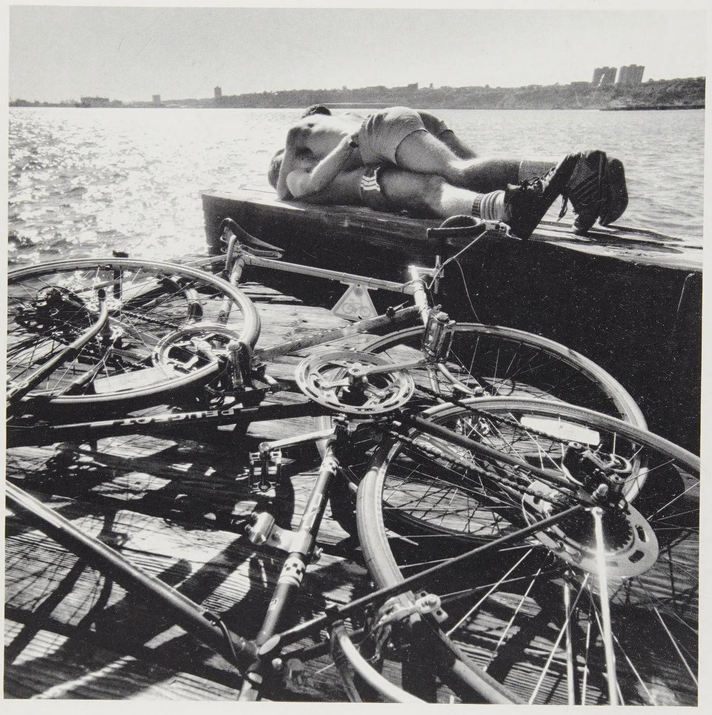
Browsing photography books on a recent rainy day I flipped through a book titled Facing Up by photographer Arthur Tress. I had not heard of him before and had never seen any of his photographs. It was an exciting bit of discovery to find something unfamiliar and immediately love it like in my younger days of looking across a dance floor and finding love at two in the morning.


Tress is a gay male American photographer born in Brooklyn in 1940. His first experience with a camera came at the age of twelve, taking photographs in Coney Island and this is where he began developing his own eye for framing the world in photographs. He studied painting and graduated from Bard before moving to Paris and traveling to Asia, Africa, Mexico and around Europe. Returning to the U.S., he photographed the civil rights movement of the 60s, politics and the Beatles. For the rest of his career he has photographed urban decay, children, life in Appalachia, male nudes and many other subjects that appear in his numerous books and in the collections of museums.

He was a peer and competitor of the more well known Robert Mapplethorpe. Tress' work is much more varied and interesting than Mapplethorpe, who seemed to be obsessed with orchids and sticking objects up his own ass and the asses of others. There is a place for Mapplethorpe, his work and his admirers (count me as one), but even as someone who has stood in museums and admired the stunning work hanging on a wall at close range, I do not get any sense of soaring or delightful inspiration from his work. Mapplethorpe, without fail, leaves me cold. 

Arthur Tress, Facing Up.

Arthur Tress, Facing Up.

Arthur Tress, Facing Up.

By contrast, the male nudes by Tress in Facing Up are playful, fun, imaginative and still retain their eroticism without relying on vulgarity to shock a viewer. I get a sense of humor behind the photographs that dulls the edgy seriousness of the skill that it took to pose the models and shoot them. The intimacy between the eye behind the camera and subject feels natural.

Arthur Tress, Facing Up.


Arthur Tress, Facing Up.

Arthur Tress, Facing Up.

The photos in this book were shot in the late 1970s. Tress lived on the west side of Manhattan near the abandoned Christopher Street Piers along the Hudson River that have since became infamous in gay history before the AIDS epidemic. The piers were a place where gay men would nude sun bathe, cruise for sex, do drugs, and engage in prostitution among other elicit activities. Among those ruins, artists such as Peter Hujar and David Wojnarowicz would create  their art and find inspiration. It was Tress who introduced Wojnarowicz to the piers. Not in this book, but of note is that Tress also photographed in the cruising grounds of The Rambles in Central Park in the more secretive era of the mid 1960s.

Arthur Tress, Facing Up.


Arthur Tress, Facing Up.

This photograph titled Band-aid Fantasy taken in 1977 is my favorite from the book. There is a tenderness about this photo and the peeling away of the band-aid from the bare leg. There is sexiness too with the long legs of the two males exposed from the short shorts sitting alone together on the stairwell. As with all great photographs it is also an excellent manipulation of light and shadow. Arthur Tress, Facing Up.
 

Facing Up was first published in 1980 and again in 2004. If you can find a copy then grab it. Out of his long career and the accolades that he has received, it appears that his photos of gay life have been the least exhibited and the least appreciated. His photos of gay life deserve more recognition.  Stanford University does host an online collection of seventy of his photographs, including some of the nudes from Facing Up, here titled Gay Fantasies.


There is a recent documentary that has  been made about Arthur Tress titled Arthur Tress: Water's Edge.   Unfortunately, it does not appear to be widely available and I have not seen it.


Further reading about Arthur Tress: an excellent, lengthy interview with him from 1999.


Monday, April 10, 2017

Dispatch: Dinners, Berlin, Cats, Bunnies And The Hiding Stranger

Atlanta Monday evening. Taken from a webcam.

The evening was unfolding and I was relaxing by listening to shortwave radio. I had found a station out of the U.K. and they were playing The Devil Inside by INXS. Their music sounded better today than it did back when it was new in the late 80s. I liked the band then but compared to today's rock it holds up well. That song is a playful jaunt and devious too, I like it.

My quiet and contemplative mood that has taken hold in me since last fall is still lingering in me. I went to a couple of dinners in the past week and noticed I wasn't all that engaged in the conversation. I was spending too much time listening and not enough time taking an active role but I guess it doesn't much bother me. This was the most socially active I have been since October last year.

One dinner was a friend's birthday dinner and another was a going away dinner for yet another friend that is moving to New York. I think I know more people in New York now than I do in Atlanta.


I saw this Berlin poster a couple of weeks ago on a blog that I read from time to time and I fell in love with it. I would love to have a large wall poster version of this. My fascination with Berlin remains strong.


I have watched a couple of interesting movies: If Cats Disappeared From The World and How To Draw A Bunny. The movie with cats in the title was a sentimental Japanese movie that I often enjoy. It was a sad emotional story about a young man coming to terms with his mother's death and his own impending death. I didn't cry but I was close to tears near the end.

How To Draw A Bunny is a documentary about the artist Ray Johnson. I must admit I was only slightly aware of him and his oddly composed signature bunnies. His collages were interesting though  and very intricate like a complex puzzle. The documentary explores his life from stories about his friends and how he was on the New York art scene and his curious personality until his death in 1995. His death received speculation that it was maybe his final piece of performance art or just an ordinary suicide by an elderly man. I lean towards thinking his death being an intentional mystery in which he wanted it to be another piece of art.

There is one mystery that I am trying to understand in my life and that involves some odd guy that I have caught twice hiding outside my fence watching me. The first time I pretended not notice him hiding and I went inside. I then watched out the window as he got up from his hiding spot at the fence and then quickly walked down the sidewalk once he thought I didn't see him. The second time I caught him hiding at the fence watching me I decided to make it obvious that I saw him and stood outside my door and stared at him. Finally he realized that I was watching him watching me and he ran away down the street.  It worries me some because I don't know what this is about. I don't think he is going to attack me but is he trying to watch my place and break in? If I see him again I might confront him or maybe not. I am sort of enjoying this cat and mouse game with this strange guy that sometimes hides at my fence. I don't know enough about the situation yet to involve the police.

Friday, November 11, 2016

Rethinking Reeve

Street Smart 1987

In 1987 Christopher Reeve was looking to expand his movie career beyond the Superman franchise. New York was still suffering astronomical crime and decay. AIDS was the misunderstood plague and the closeted mayor Ed Koch was in his third term. Street Smart, a movie about a dishonest journalist, a murderous pimp and the colorful street life of New York when Times Square was still exciting and not in a Disney way was relevant for the time.

Street Smart 1987

Street Smart was a personal project for Reeve, he had purchased the rights to it four years earlier and struggled to get it produced. He only agreed to do the last Superman movie so that Cannon Films would bankroll Street Smart for him. The movie had a limited opening in March of ‘87 and was only shown in 207 theaters before closing. It was a minor film that only grossed just over $1.1 million. Just a few months later in July Superman IV would open also starring Reeve and Street Smart would be forgotten.

In the same year Three Men and a Baby, Fatal Attraction, Beverly Hills Cop II and Good Morning Vietnam would all gross over $100 million at the box office to illustrate how poorly Street Smart did by comparison. However, box office receipts are not the only indicator as to whether or not a film is any good.

Imagine Morgan Freeman as a killer pimp. He was incredible in the bad guy role.

Street Smart was a clever film that never found an audience despite positive reviews. The only recognition it ever achieved was the much deserved Oscar nomination of Morgan Freeman for best supporting actor. The weekend it opened audiences were more interested in watching Lethal Weapon, Platoon and Nightmare on Elm Street 3. Even Christopher Reeve, the heroic Superman, could not persuade audiences with his star power to see his thriller with him cast as a New York reporter.

Almost thirty years had passed and I had never heard of this movie until last week. Once I watched it, I realized I had missed out on this excellent movie and it was as if I had discovered a collectible camera or book in a thrift store at some ridiculously low price.
This movie captures an era of New York street life that's gone.
From the clothes to the setting this is a beautiful movie to watch.

Some of the appeal I will admit is my nostalgia for the clothing, my attachment to the pre-internet and cell phone world, my romanticism of the gritty Manhattan I never got to experience as a teenager in rural Georgia in ‘87 as a freshman in high school and the stunning beauty that was Christopher Reeve.
I had a wind breaker just like that.

The script is not perfect and there are a couple of plot holes, but  this is a well done movie that is entertaining and intelligent. It stands up better today than anything Mel Gibson ever made and Christopher Reeve though being a rather stiff person was actually a good actor that never got much respect. Perhaps it was because of the Superman success or from his paralyzing horse jumping accident eight years after this movie that cut his career short. He was Julliard trained, a veteran of Broadway, was surprisingly versatile and was the perfectly chiseled leading man, but even still he is not widely known for being a great actor. He is still known as Superman and the guy who was paralyzed by a horse.
Reeve was very lanky at 6'4.
You could wear that shirt again today and be in style.

It seems in three decades that this movie has been forgotten. You won’t find it running at midnight on a basic cable channel, streaming on Netflix (though it can be found on their DVD service) or ever mentioned anywhere when people discuss their favorite movies of the 1980s and it isn’t a cult classic either. For it to be such a good movie it is a shame that is goes unrecognized and unseen. Street Smart falls into the category of underrated movies that are very good and only film buffs seem to remember but if they were more widely known more people would enjoy them. Movies that are similarly underrated and forgotten from the 80s are Apartment Zero, Diva, Love Streams, Kiss Me Goodbye, Garbo Talks and Author! Author!
 
Reeve would write in his 1999 autobiography, Still Me, that he was “deeply depressed” leading up to this movie and changed his management company. He went on to say the Street Smart/Superman IV deal “turned out to be a disaster.” He said that no money was spent on advertising Street Smart despite the good reviews and that it quickly vanished. He described Superman IV as a catastrophe and that this period was a “huge blow” to his career.
 
He would go on to act in a few other films like Remains Of The Day before his near fatal accident in Virginia in 1995 but television and theatre would be his primary acting outlet as his film career never soared again.
Street Smart mentioned in the March 1987 issue of Jet Magazine. That's Anne Bancroft below in 84 Charing Cross Road which is another good movie.

Equally as good and maybe even better is Deathtrap starring Reeve in 1982. In this film Reeve plays a young playwright caught up in a murder mystery in the Hamptons. Reeve shows his acting range in this role and he’s a little too believable playing opposite Michael Caine. Deathtrap is directed by one of my favorite directors, Sidney Lumet, and the film keeps you guessing until the end as to whom did what and why.
 
If you happen to be looking for something to watch that you may not have seen before and you aren’t allergic to thirty year old movies that aren’t completely CGI or based on comic book characters then maybe go watch some of Reeve’s other movies.

Thursday, December 31, 2015

See Ya 2015


A

s a kid I was addicted to Take It Away, I had to even buy the single on 45 vinyl. I played a lot of vinyl or what we called records back in the 1980s. Hipsters had not come along then with their retro turntables, making some kind of poseur statement yet to sneer at calling vinyl a record.

The funny thing is, I've never been a McCartney fan, he's okay, but I was more of a John Lennon fan and still am today. After Lennon was murdered, McCartney was still relevant and popping out hits on pop radio. I can imagine that Lennon might have been just as successful if he had not been murdered.

The video is interesting as it features the famous actor John Hurt. Hurt is one of my all-time favorite actors. In the video, he plays his role with as much effort as he would a movie and appears to have taken  it just as serious. He tosses out a few smirks which I adore.

Maybe it's the saxophones or the trumpets or the smooth as velvet backing vocals, but this song is still a favorite of mine from the 80s. Hell, maybe I thought McCartney was cute when I was a child. I realize it is possibly strange now, but I definitely had a crush on John Hurt.


Anyway, it's the last day of 2015 and tomorrow we change the number to 2016. I guess it wasn't so bad a year. I walked the streets of several cities, saw some new beaches, climbed a few mountains, watched a lot of damn good movies, read some good books and didn't add too many wrinkles.

So, take it away!


Monday, February 5, 2007

Not Just Atlanta

Many in Atlanta have complained for the last few years about the dying nightlife or at least the taming of it by the city. The party on Peachtree Street is a thing of the past and the wildest time you might have is jay walking at 10th street. The city has been harsh on clubs that allegedly violate the law, imposing stiff fines, revoking licenses, rolling back the time of last call and so on.

I can't remember how many times I've seen someone from the Fire Marshal's Office come barging into a club at midnight, counting heads and looking for violations. Talk about killing a mood to see some stiff wearing a uniform marching. The businesses that sell you alcohol operate under greater scrutiny than the people that replace the brakes on your car. Where's the logic in that?

Gentrification has had a hand in taming the nightlife too. It wasn't just the city that put Backstreet out of business it was the neighborhood and the residents that go to bed at 10PM on Saturday night that helped end the 24 hour party. These days a bar closes and in a few months a new condo tower starts construction on the very spot you danced to IIO with a Peroni in hand and next to that night's nameless trick. The mother of American nightlife, New York, has also fallen on tough times too thanks to the city government and gentrification.

Yes, even New York has citizens that loathe the idea of going out at night and having a good time. Tricia Romano of the Village Voice tackles the topic and lists some of the new restrictions that New York club-goers could soon face. Like ID scanners before you can grace the door of your favorite haunt. Imagine some government agency building a database of how many times you went Jungle or the Eagle last month.

Let's hope Mayor Shirley doesn't read the Village Voice or you too might have to have a scanner approve your entry into Blake's in the near future.