Showing posts with label Book. Show all posts

Wednesday, April 15, 2026

The Internet Is A Bad Neighborhood


On a recent road trip coming northward out of Sarasota we detoured to Jacksonville. After the time in Jacksonville we were in an awkward spot to get home to northern Georgia. If only using the interstates to travel it would have meant going out of the way westward on I-10 to I-75 or heading north on I-95 to I-16 in Savannah and then getting on I-75 in Macon. Logistically it made no sense. I decided the old fashioned way of studying a map and choosing back roads was the better option and would be more interesting. Off we went across the Okefenokee Swamp in southern Georgia zigging and zagging through Waycross, Alma, Hazelhurst and many other towns. It was a fun drive, with no traffic and no stress. I would do it again and maybe change it a little to see new towns unseen.


I am still attempting to visit every one of the one hundred and fifty-nine counties in Georgia which is the second most to Texas in the number of counties. I do not have many left as I have visited well over a hundred of them. On this trip I added Bacon, Appling, Jeff Davis and Dodge counties to my total. I feel like I have been to more counties in this state than the politicians that claim to represent it.


On the drive I kept thinking about simpler and saner times. Country roads have a way of stripping away the man-made artifices, modern technology and information overload and the troubles of the world that really have no direct bearing on my life. The roads passed through the endless pines, the green fields, by the barns, over the creeks, rivers and swamps and by houses large and small. I like to think of the countryside as reality and cities as artificial bubbles.

The American flag at rest on Broad Street in Monroe, Georgia. Photo by me, April 2026.

When President Carter died in 2024 I watched his funeral. Some of my motivation was a sense of obligation since he was, like me, a son of Georgia, but mostly it was admiration that made me watch. Carter's presidency has felt like the end of simpler and saner times in part because it was the end of the 1970s and also because of the person he was, the son of a South Georgia farmer. His funeral was more than his own, it was the funeral of the last vestiges of simpler and saner times in America and decency too. I would like to think that one day this country will be sane again, but that would require both sides reversing their charge to the extreme ends of politics and returning to where some of us live in the middle. I have no hope of it happening. I love this country, am proud of it, but I think we are fucked by both sides who are too blinded by their smugness and self righteousness for the foreseeable future and perhaps the remainder of my life. It did not have to be this way.


"Nor had topsawyer's rocks by the stream Oconee exaggerated themselves to Laurens County's gorgios while they went doublin their mumper all the time." - James Joyce writing about Dublin, Georgia on the opening page of Finnegans Wake


Dublin, Georgia. Photo by me, April 2026.
 
Dublin, Georgia. Photo by me, April 2026.

Dublin, Georgia. Photo by me, April 2026.

I recently stopped in Dublin, Georgia in Laurens County for the first time. I had a good dinner in their pleasant downtown. The restaurant was busy, people were out on the sidewalks in the evening and it was good to see another small Georgia town's downtown thriving. 


Monticello, Georgia. Photo by me, 2026.

Monticello, Georgia. Photo by me, 2026.

Later, before making the final leg home we stopped in the square of Monticello. It is another small Georgia town with a downtown that thrives. I have watched several sunsets in the past few years from that square on my way back from other places. The back roads seem to take me through there no matter from where I was coming. There is something so peaceful and calming about that square at sunset. The world feels okay there.

I have noticed this many times, but in small towns life still feels sane and normal for the most part. There is a great divide between small towns and the cities much like American politics. It is in cities and large suburbs where people ignore out of fear or complacency the crazy, the bad manners, incompetent drivers, dangers and the growing incivility of American life. Small towns are where the life and the country I knew growing up still exists in large part. It is weird for me to feel this way as it requires me to admit that I was wrong for decades of my life when I thought cities were better.


I wish American cities were cleaner, safer and more polite, but they are not and it should not be tolerated or accepted and yet it is. Is it apathy by the citizens, the local governments and police? Yes and it is up to them to take responsibility and solve those problems. In bad neighborhoods people say to look the other way and are told to mind their own business. Looking the other way is cowardly and shreds any sense of community which leads to bad neighborhoods. If taking care of one's community is not minding one's own business and is not in one's own best interest then nothing is.


Somewhere near Milledgeville, Georgia John Cougar Mellencamp's Small Town played on the radio. I sang along. I thought about my mother, she was a huge Mellencamp fan. The world was okay on that back road and in that reality. 


Me on the beach in Sarasota, Florida. April 2026.


With that written and after walking miles around a lake on Monday, I am putting my long form blog, Notes from Rabbit Tobacco Field, on indefinite hiatus. I am deep into writing my next novel and I do not have the spare mental capacity to keep writing long form posts for a blog. I have to concentrate on novel writing.


Another reason, is that I do not desire for my blog to become what I disliked about the men of the previous generation who talked back to the television news and complained about everything. I notice the men of my generation do it on Facebook or other social media and I find it negative and annoying. I do not want to contribute to that type of discourse on the internet nor waste my time consuming it.


Also, I have been pulling back my time from the internet in general. My use of the internet for any purpose has declined significantly over the last year. I spend very little time on the internet surfing or browsing as if I have seen the end of the web and it is suffocated with bots and AI. The web I started with in the mid 1990s that was human, cool, interesting, filled with originality, was mostly friendly and not so commercial is dead and has been for a long time. The greatest invention for the average person in my fifty plus years of living was ruined. It did not have to be this way. The internet became the ultimate bad neighborhood.


Finally, I like my privacy more than this blog. The internet's influence on society and the current politics are enough to make a person become a misanthrope and to be thankful for the gates that we have control over.


This website is not dying, but changing and will still serve as my primary outlet for my books. I will keep posting periodic updates about my next novel.


Thank you for reading,

Chris M. Vise


Wednesday, February 18, 2026

Dispatch: Accent In My Pocket

Sometimes the world is so flat it feels like you could slip free of Earth's gravity and slide off. Early February on the road. Photo by me, 2026.


The tail end of January and the beginning of February was two weeks on the road, sometimes dirt roads, of the south. It was the winter thaw for the mind collecting new sights, sounds, scents, tastes and discarding the mental plaque of the previous year. I wore my accent when needed, gave nods of indifference to strange politics of strangers and found myself shooting the shit in the middle of the road with locals. I wandered for hours through another history museum, watched water flow and listened to the birds in the trees. There was lots of bad coffee in gas station travel cups too. Some of the experience might end up in a book or maybe in a blog post. I thought a lot about the death of an old best friend between the mile markers and the hash marks on the speedometer. I wanted one more stupid teenage argument with him for the fun of it. This is how life and death go as the inseparable pair that they are.

Columbus, Georgia. Photo by me, February 2026.

I came home to bulbs waking up from winter and sat behind my desk. It was time to get back into the rhythm of writing my next novel.  

Golly gee. Tell me about them lyrics son. You are one pontificating rascal, that's what you are.

Somewhere I was in a bookstore and noticed in the prominent displays by the door a stack of poetry books with the bedraggled face of the hammy actor Matthew McConaughey. He is the actor/renaissance man who straight guys of my generation have crushes on and secretly wish they were. As you can tell by the sepia toned cover photo Matthew is a man with deep thoughts with his half open shirt and is surely in the running for a Pulitzer. Poems & Prayers is exactly the book that the world does not need, but it is what it gets. Traditional publishing is on a mission to destroy and humiliate itself in the most shameless ways. I hope he publishes a cook book next. Maybe something called Corn & Coca-Cola.

I read this Atlantic piece on Rod Dreher. It was interesting as the writer attempted to portray Dreher as some noble romantic fighting to save the soul of Western culture from Budapest, but instead he seemed miserable in a fantasy world of his own making. I have only read a few pieces by him over the years, though I have known about him for a long time, and Dreher is a peculiar one. The slipping in of the line by the brilliant and highly regarded atheist Richard Dawkins about him being a “cultural christian”, which I am familiar with, is intellectually dishonest with the usage of “declared” as if it were some major proclamation from on high (it wasn't) and it is very troubling for the use of “ally” (it is laughable to suggest he is, since Dreher is anti-science) and there is zero context given. I remember Dawkins saying that remark either in a debate or interview and it was not a grand gesture as it was a reference to how he was raised during his childhood without a choice on the matter. I respect and agree with Dawkins more than I ever could with Dreher. The tone of the article seemed to be a weird attempt to launder the ideas of Dreher and position him for future shadowy political influence in the United States.


Most of Carlton, Georgia. All five of these storefronts are occupied by this one antique store. Photo by me, February 2026.

One day well east of Athens in Madison County near the Elbert County line we stopped in the tiny community of Carlton clinging to life next to the train tracks. It is the kind of place you have to pull off the main road and intentionally seek out or you would never have a reason to pass through. Few people do as evidenced by the population change from 1900 to 2020 that was a loss of fourteen people in one hundred and twenty years down to two hundred and sixty-three. I find it charming that communities like this have managed to survive safe from Atlanta's sprawl. I remember when places like this were the norm in North Georgia outside of metro Atlanta in the 1980s.

Photo by me, February 2026.

This is the kind of place you have to dig, maybe get a little dusty and you will be rewarded. Two buildings down to the left next to the post office is a local branch of the Hell's Angels. I suppose they will not bother you if you do not bother them.

Photo by me, February 2026.

You do not know the smile and warm feeling I had when this jukebox played Don't Make My Brown Eyes Blue by Crystal Gayle. I skipped by like the small child I was in 1977 when my mother would play this record on our living room stereo which was near the same size as this jukebox. 


Photo by me, February 2026.


A cat strolled through on its rounds as I flipped through a copy of the photo book Warhol and Friends.

Photo by me, February 2026.

It was digging paradise where prices are rough ideas. 

Athens, Ga. Photo by me, February 2026.

 
Athens, Ga. Photo by me, February 2026.

Another day I attended a festival in downtown Athens and tried to shake loose a ghost. That old best friend of mine who recently died lived there in the early 1990s while he attended UGA. He went off to New York afterward to work in historic preservation. Athens of the '90s was a different place from the Athens of today, kind of like most of the state. It was one of the hot music scenes at the time like Seattle.

This is REM performing live in their hometown at the 40 Watt (pictured above) in 1992.


And so it goes... 

Me. February 2026.

on the road with an accent in my pocket chasing those sunny days.

Tuesday, September 2, 2025

From Green To Brown


Summer's death duly noted in Athens, Ga. Photo by me, August 2025.

Summer died on the backs of my knees in a cool, dry breeze this past Sunday in Athens. It was a recognition the same as the flocks of birds beginning the migration south as they speckled the sky of smeared clouds. It was a relief as if I had accomplished something more than play witness to the passing of another season. I was running errands and the surname of the protagonist of my current novel had come to me. I had been stressing over this not-so-minor detail for months. The last name had to sound right or sing when spoken aloud with the first name and I had paired numerous names in my head without success. Then in a parking lot among the first tinges of fall color in the sugar maples it came. The name was simple, solid and was a fine tonic to the more complex first name. The character was fully born.


Fiona Apple's album When the Pawn...

I have been listening to lots of Fiona Apple the past couple of weeks and this happens to me most every fall. I am the eternal fan. Her music reminds me of Louisville in the 1990s and a particular autumn when I thought everything in life was as perfect as life could get. I was in my twenties and foolish; what else can I say? Life is never perfect except in small increments and the good news is that it happens even long after the twenties are nostalgic memories. Perfect in a parking lot in the breeze in Athens, Georgia kind of way or perfect in the sense of appreciating happiness in victories over creative blocks.


With perfection comes the imperfection and Saturday we attended an arts festival on the square over in faraway Marietta. I can do without ever attending another arts festival for the rest of my life. I am so tired of seeing booths of the same makeshift art projects made in garages and basements with glue guns, glitter and limited inspiration.


The book cover of Pieces of the Frame by John McPhee.

Labor Day was about getting in the miles on the legs through the woods, reflections on a lake and feeling fresh in the crisp air. Fall is a rejuvenator not sold in a bottle at the cosmetics counter or in the energy drink aisle at the grocery store. Deer foraged in the shadows and my mind thumbed thoughts on the book I have been reading, Pieces of the Frame (1975) by John McPhee. There was a story in the essay, Travels in Georgia, about McPhee, Sam Candler (an heir to the Coca-Cola fortune) and Carol Ruckdeschel (a conservationist) canoeing down the Chattahoochee River with then-Georgia Governor Jimmy Carter with Georgia State Patrol troopers as bodyguards. Carter, a country boy, a former Navy officer and an avid outdoorsman, fit perfectly into the canoe trip, which was meant to serve as a way to convince him to protect the land along the Chattahoochee, which he did as President of the United States. After the trip, the group ate grilled cheese sandwiches at a twenty-foot table under a crystal chandelier and then played basketball in the driveway of the governor's mansion on West Paces in Buckhead, a thirty-room Greek Revival home I toured as a kid in the 1980s, either during the George Busbee or the first Joe Frank Harris administration. I thought, “Well that kind of politician no longer exists,” but politicians sure like to play up and pander to the average common person when trying to get elected. Carter, disparaged by people who have never done a decent day's work in their life, unlike the phonies, was genuine. Since 1980, if you are as old as I am, you have to wonder what people value and expect from their presidents.


Sunday Bloody Sunday

Monday wound down as I re-watched Sunday Bloody Sunday from 1971 starring Glenda Jackson, Peter Finch and Murray Head. The movie, nominated for four Academy Awards, is about a love triangle between a straight woman, a gay male Jewish doctor and a bisexual artist. It was the right cozy movie to start fall with the drab London weather and scenery and what I like most about that movie is the abundance of brown fashion. 

All the world is beautifully exquisite seventies brown.

Every character lives in shades of the color brown from scarves, jackets, pants, coats, vests, sweaters, ties, turtlenecks and so on. The costume design was by the late Jocelyn Rickards who also designed for Blow-Up, From Russia With Love and many other films. She was a painter too and published her autobiography in 1987. It is very 1970s, as I remember that decade. Brown is a color not worn enough anymore. It is a sophisticated color that works well in any season and people should wear it. It is also the better choice between it and another popular seventies color, ghastly orange which is best suited for pumpkins. Perhaps the reason people do not is because it is a modest choice and does not garner enough attention in our narcissistic decadent times.


Other than Fiona Apple it seemed to be an all-out seventies entertainment weekend as the season turns from green to brown.


Friday, July 4, 2025

The Mid Point of 2025

Happy Fourth of July from Broad Street in Monroe, Georgia. Photo by me, June 2025.

It was during a hiking trip last fall and sitting in a barbecue joint in Gainesville, Georgia when I knew I had enough notes and ideas to begin writing the first draft of a new novel. This realization was a nice change from when I had stood in Micanopy, Florida in September chasing down the ghost of River Phoenix. I was undecided if I was on a wild goose chase or if I was seeking twisted inspiration. Inspiration can come from anywhere I suppose, even from long dead movie stars with bad drug habits. 

The town square of Gainesville, Georgia. October 2024.

After eating, I walked around the square and aired out my thoughts like sheets on a clothes line. I had two people in mind who I had known that I could use as inspiration for characters. One was a prim and proper person and the other was a person who lived below their raising and had wasted their chance at life. These two would be among the foundational characters at the heart of the novel. I decided to set this story primarily in two places I know well, Monroe, Georgia and Athens. River Phoenix and Micanopy, Florida might still figure into this somehow or maybe not, River did spend time in Athens hanging out with Michael Stipe in the 1990s. 

"The bike is the answer." Athens, Georgia. Photo by me, April 2014.

At the mid point of this year, this book is a long way from being finished and I am still writing the first draft. There will be no new book from me in 2025. Other than what I have written above, the only new tease I have for this book might be found in the Eagles song One of These Nights crossed with the mood and themes of the Chris Isaak song Wicked Game. A previous tease can be found in a post here.


A week ago, Shadow's Gravity had its one year anniversary and I updated the cover.  

The new cover features a portion of a photo of my mother from the late 1940s when she was a toddler. She was holding on to the back of a parked Mercury and had dropped her toy cat. 

Tuesday, June 10, 2025

The Death of Edmund White


The first gay book that I ever read was in the early 1990s and it was A Boy's Own Story by Edmund White. I nervously ordered it through the Barnes & Noble mail order catalog since there were no stores anywhere near me in rural Georgia. Ordering it through the mail also saved me the embarrassment of buying it in person in a store in Atlanta. The coming of age story was all too familiar to my own experience and it helped connect me to a larger gay world that I knew existed, but was too shy to join. My relationship to that book was likely the same as many other young gay men of Generation X and the Baby Boomer generation.


Edmund White became an inspiration to me and a personal favorite among gay writers.  I went on to fall in love with The Beautiful Room Is Empty and The Farewell Symphony which were also based on his life. That trilogy of novels were the model on which I based my own novels about my life as a young gay boy to early adulthood. I owe a debt to Edmund White and so do many other gay writers of my generation.


Edmund White died last week at age eighty-five in Manhattan. The obituaries and tributes spilled across the internet from across the literary spectrum and from fans in praise of his work. He was a gay literary legend and everyone in that world knew him, met him or he knew them; he was often a notorious name dropper  in some of his books and interviews. White left behind a husband, a legacy of over thirty books and a rich life. He lived in Rome, New York, San Francisco and Paris during the sexual freedom of the 1970s, the AIDS crisis of the 80s and 90s, more widespread acceptance of gay life in the 2000s and he had been living with HIV since 1984. He was still writing and publishing into 2025 with his last memoir, The Loves of My Life.

His New York Times obituary.

His Literary Hub obituary.

A 2014 interview of Edmund by Dennis Cooper in Interview Magazine

A 1983 interview of Edmund in The Paris Review. He discusses his writing and teaching.

In 1980, Edmund White appeared on the Studs Terkel show for an extended interview. He was promoting his latest book, a travel book, called States of Desire

From a local perspective, Atlanta is in the book and some of his observations still have some merit today. The gay scene can be racially segregated, but much of what remains is self segregation and not enforced by discriminatory door policies. The scene, as I knew it later on, was diverse in bars such as Blake's, Heretic, Ten, Burkhart's, WETbar, Jungle and other places. Gay men were far more likely to segregate along their desires for twinks, bears, leather queens or other factors.

It is interesting Edmund, who was very open about his sexual voraciousness and desire for much younger partners, comes across as a bit of a priss and hypocrite on sexuality and ageism in this interview. There is also discussion about the 1980 gay murder movie, Cruising, which was at the time despised by gay activists because it dared show sex cruising in clubs and in the Ramble in Central Park. Activists did not like what they considered a negative portrayal of gay men even though it was accurate to some degree. I love the movie and think the activists were wrong. Pacino was fantastic in it. The film was the second gay movie by director William Friedkin, The Boys In The Band from 1970, and is a classic too.


Tuesday, May 20, 2025

Tin Roof Rusted

Statham, Ga. Not the love shack, but a nod to the B-52s from nearby Athens. Photo by me, April 2025.

The last weekend of April, the sun was strong, almost summer strong. It was Sunday and we loafed into the town of Statham, Georgia, fifteen miles outside of Athens on the old Atlanta Highway. Father John Misty played on Bulldog 93, the local alternative station. In my mind thoughts turned over about an interview with the late writer David Foster Wallace in which he stated that what great artists do is “fracture reality.” I am not a Foster Wallace fan or disciple. I am of the mind that if one dared look, reality is fractured plenty and it is the job of the writer to make something of that chaos. The uncomfortably smart Foster Wallace was by his own admission and by contrast an anti-realist writer who thought of himself as avant-garde and postmodern. Yet, I did like his phrase, fracture reality.

A funky little shack. Statham, Ga. Photo by me, April 2025.

We had passed through Statham a few times and never stopped, but this day it was our destination to browse through an antique store with creaky floors and that old building smell of spiced, slow decay that I enjoy.


Photo by me, April 2025.

Statham, founded in the late 1800s in Barrow County, was once a railroad stop and cotton town with a hotel. The trains stopped stopping and the town is now mostly known as a speed trap. Those shiny police cruisers do not pay for themselves after all and if they could find a way to ticket the freight trains, they might. I saw more cops than citizens that Sunday as I stood on the treeless sidewalk wanting for shade. I looked around and decided this town waited for a reason to still exist other than for writing tickets to people going to Athens from Winder and vice versa.


"Sometimes even now, when I'm feeling lonely and beat, I drift back in time and find my feet down on Main Street," Bob Seger in the 1977 song Mainstreet. Photo by me, April 2025.

Photo by me, April 2025.

The antique store, as it turned out, was like most antique stores with few antiques and old discarded stuff piled up that was better suited for a flea market. Such is the story of modern antique stores that are anything but. The business model of these places is dependent on nostalgia which they hope will bite you in the ass like a hungry chigger and make you buy something you do not need. Maybe it is that old Hess truck you had as a boy that you left outside in the rain and mud and forgot about by the time you turned nine years old? Or maybe there is a dish your mother or grandmother had and cooked some Betty Crocker casserole in the late seventies or eighties? As if buying that Corningware with the pale blue flowers will satisfy an inner hole that cannot be filled. Are you craving that beef stroganoff over noodles yet? Antique stores in old railroad towns and the vintage shops in the city prey on that weakness. Whether it is a good deal or has any value depends on how deep that sentimental hole is inside you. But let's not lie to ourselves and call these items antiques and I will never not feel silly calling this stuff "vintage," as if I were brainwashed by a lazy, idioctic social media influencer recycling "content."


The Statham train station. Photo by me, April 2025.


"Going back to a simpler place and time," Midnight Train to Georgia by Gladys Knight and the Pips 1973. Photo by me, April 2025.

Looking in the direction of Athens. Photo by me, April 2025.

In 1991, when I was eighteen, I bought Stephen King's Needful Things, in hardback no less, and now I was reminded of it. This was not Castle Rock, Maine, but Statham, Georgia and maybe there were similarities that Sunday afternoon. I would reread the book if I had not lost my copy in a flood from a tropical storm twenty years ago. As a teenager I read everything by King and put him on my bookcase alongside Dickens, who was my favorite writer. One day I sense that I will walk into an antique/vintage store and find another copy of Needful Things on a dusty shelf and I will fight against the urge to buy it. Thirty-two years have passed since that book was published, so that must make it an antique?


People my age, in their 50s, are likely missing the design aesthetic of American Colonial Revival that was all the rage around the Bicentennial in the 1970s. Hell, I live in an American Colonial Revival house. You know you want a faux wood eagle with spread wings on the wall, a sailing ship on the center of your mantle and a wood cabinet stereo that is big enough to double as a coffin. This was when Americans were proud to be Americans; we loved our fireworks, disco and short shorts and it was before colonial and all of its variants became dirty words. It was also before that pandering, awful Lee Greenwood song had ever been thought.

The center of Statham and the center of a moment of my nostalgia. Photo by me, April 2025.

America was great, I thought as I stood at the “very center” of Statham and I did not need a politician or a patriotic country song to remind me. Here is a wild thought: maybe it was better in the 1970s? In some ways it was and others not.

People must come from all over Barrow County just to see this monument and rub their finger across it in awe as I did. Statham must surely have a reason to exist and maybe one day people will line up for selfies in this very spot like they do at that deodorant stick looking monument in Key West. Until then, this is the fractured reality.


Elton John - Philadelphia Freedom

Friday, February 14, 2025

Tress Facing Up

Arthur Tress, Facing Up.


Browsing photography books on a recent rainy day I flipped through a book titled Facing Up by photographer Arthur Tress. I had not heard of him before and had never seen any of his photographs. It was an exciting bit of discovery to find something unfamiliar and immediately love it like in my younger days of looking across a dance floor and finding love at two in the morning.


Tress is a gay male American photographer born in Brooklyn in 1940. His first experience with a camera came at the age of twelve, taking photographs in Coney Island and this is where he began developing his own eye for framing the world in photographs. He studied painting and graduated from Bard before moving to Paris and traveling to Asia, Africa, Mexico and around Europe. Returning to the U.S., he photographed the civil rights movement of the 60s, politics and the Beatles. For the rest of his career he has photographed urban decay, children, life in Appalachia, male nudes and many other subjects that appear in his numerous books and in the collections of museums.

He was a peer and competitor of the more well known Robert Mapplethorpe. Tress' work is much more varied and interesting than Mapplethorpe, who seemed to be obsessed with orchids and sticking objects up his own ass and the asses of others. There is a place for Mapplethorpe, his work and his admirers (count me as one), but even as someone who has stood in museums and admired the stunning work hanging on a wall at close range, I do not get any sense of soaring or delightful inspiration from his work. Mapplethorpe, without fail, leaves me cold. 

Arthur Tress, Facing Up.

Arthur Tress, Facing Up.

Arthur Tress, Facing Up.

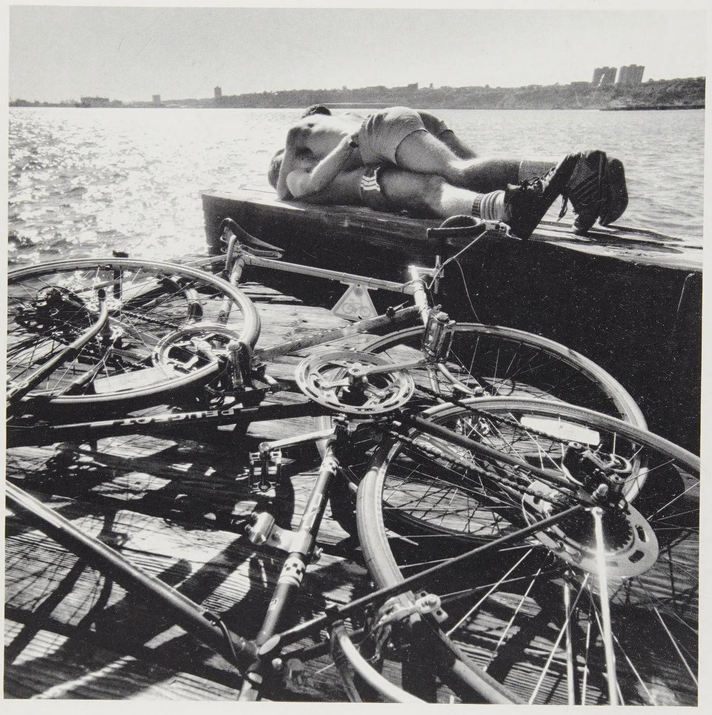
By contrast, the male nudes by Tress in Facing Up are playful, fun, imaginative and still retain their eroticism without relying on vulgarity to shock a viewer. I get a sense of humor behind the photographs that dulls the edgy seriousness of the skill that it took to pose the models and shoot them. The intimacy between the eye behind the camera and subject feels natural.

Arthur Tress, Facing Up.


Arthur Tress, Facing Up.

Arthur Tress, Facing Up.

The photos in this book were shot in the late 1970s. Tress lived on the west side of Manhattan near the abandoned Christopher Street Piers along the Hudson River that have since became infamous in gay history before the AIDS epidemic. The piers were a place where gay men would nude sun bathe, cruise for sex, do drugs, and engage in prostitution among other elicit activities. Among those ruins, artists such as Peter Hujar and David Wojnarowicz would create  their art and find inspiration. It was Tress who introduced Wojnarowicz to the piers. Not in this book, but of note is that Tress also photographed in the cruising grounds of The Rambles in Central Park in the more secretive era of the mid 1960s.

Arthur Tress, Facing Up.


Arthur Tress, Facing Up.

This photograph titled Band-aid Fantasy taken in 1977 is my favorite from the book. There is a tenderness about this photo and the peeling away of the band-aid from the bare leg. There is sexiness too with the long legs of the two males exposed from the short shorts sitting alone together on the stairwell. As with all great photographs it is also an excellent manipulation of light and shadow. Arthur Tress, Facing Up.
 

Facing Up was first published in 1980 and again in 2004. If you can find a copy then grab it. Out of his long career and the accolades that he has received, it appears that his photos of gay life have been the least exhibited and the least appreciated. His photos of gay life deserve more recognition.  Stanford University does host an online collection of seventy of his photographs, including some of the nudes from Facing Up, here titled Gay Fantasies.


There is a recent documentary that has  been made about Arthur Tress titled Arthur Tress: Water's Edge.   Unfortunately, it does not appear to be widely available and I have not seen it.


Further reading about Arthur Tress: an excellent, lengthy interview with him from 1999.