Tuesday, June 10, 2025

The Death of Edmund White


The first gay book that I ever read was in the early 1990s and it was A Boy's Own Story by Edmund White. I nervously ordered it through the Barnes & Noble mail order catalog since there were no stores anywhere near me in rural Georgia. Ordering it through the mail also saved me the embarrassment of buying it in person in a store in Atlanta. The coming of age story was all too familiar to my own experience and it helped connect me to a larger gay world that I knew existed, but was too shy to join. My relationship to that book was likely the same as many other young gay men of Generation X and the Baby Boomer generation.


Edmund White became an inspiration to me and a personal favorite among gay writers.  I went on to fall in love with The Beautiful Room Is Empty and The Farewell Symphony which were also based on his life. That trilogy of novels were the model on which I based my own novels about my life as a young gay boy to early adulthood. I owe a debt to Edmund White and so do many other gay writers of my generation.


Edmund White died last week at age eighty-five in Manhattan. The obituaries and tributes spilled across the internet from across the literary spectrum and from fans in praise of his work. He was a gay literary legend and everyone in that world knew him, met him or he knew them; he was often a notorious name dropper  in some of his books and interviews. White left behind a husband, a legacy of over thirty books and a rich life. He lived in Rome, New York, San Francisco and Paris during the sexual freedom of the 1970s, the AIDS crisis of the 80s and 90s, more widespread acceptance of gay life in the 2000s and he had been living with HIV since 1984. He was still writing and publishing into 2025 with his last memoir, The Loves of My Life.

His New York Times obituary.

His Literary Hub obituary.

A 2014 interview of Edmund by Dennis Cooper in Interview Magazine

A 1983 interview of Edmund in The Paris Review. He discusses his writing and teaching.

In 1980, Edmund White appeared on the Studs Terkel show for an extended interview. He was promoting his latest book, a travel book, called States of Desire

From a local perspective, Atlanta is in the book and some of his observations still have some merit today. The gay scene can be racially segregated, but much of what remains is self segregation and not enforced by discriminatory door policies. The scene, as I knew it later on, was diverse in bars such as Blake's, Heretic, Ten, Burkhart's, WETbar, Jungle and other places. Gay men were far more likely to segregate along their desires for twinks, bears, leather queens or other factors.

It is interesting Edmund, who was very open about his sexual voraciousness and desire for much younger partners, comes across as a bit of a priss and hypocrite on sexuality and ageism in this interview. There is also discussion about the 1980 gay murder movie, Cruising, which was at the time despised by gay activists because it dared show sex cruising in clubs and in the Ramble in Central Park. Activists did not like what they considered a negative portrayal of gay men even though it was accurate to some degree. I love the movie and think the activists were wrong. Pacino was fantastic in it. The film was the second gay movie by director William Friedkin, The Boys In The Band from 1970, and is a classic too.


Tuesday, May 20, 2025

Tin Roof Rusted

Statham, Ga. Not the love shack, but a nod to the B-52s from nearby Athens. Photo by me, April 2025.

The last weekend of April, the sun was strong, almost summer strong. It was Sunday and we loafed into the town of Statham, Georgia, fifteen miles outside of Athens on the old Atlanta Highway. Father John Misty played on Bulldog 93, the local alternative station. In my mind thoughts turned over about an interview with the late writer David Foster Wallace in which he stated that what great artists do is “fracture reality.” I am not a Foster Wallace fan or disciple. I am of the mind that if one dared look, reality is fractured plenty and it is the job of the writer to make something of that chaos. The uncomfortably smart Foster Wallace was by his own admission and by contrast an anti-realist writer who thought of himself as avant-garde and postmodern. Yet, I did like his phrase, fracture reality.

A funky little shack. Statham, Ga. Photo by me, April 2025.

We had passed through Statham a few times and never stopped, but this day it was our destination to browse through an antique store with creaky floors and that old building smell of spiced, slow decay that I enjoy.


Photo by me, April 2025.

Statham, founded in the late 1800s in Barrow County, was once a railroad stop and cotton town with a hotel. The trains stopped stopping and the town is now mostly known as a speed trap. Those shiny police cruisers do not pay for themselves after all and if they could find a way to ticket the freight trains, they might. I saw more cops than citizens that Sunday as I stood on the treeless sidewalk wanting for shade. I looked around and decided this town waited for a reason to still exist other than for writing tickets to people going to Athens from Winder and vice versa.


"Sometimes even now, when I'm feeling lonely and beat, I drift back in time and find my feet down on Main Street," Bob Seger in the 1977 song Mainstreet. Photo by me, April 2025.

Photo by me, April 2025.

The antique store, as it turned out, was like most antique stores with few antiques and old discarded stuff piled up that was better suited for a flea market. Such is the story of modern antique stores that are anything but. The business model of these places is dependent on nostalgia which they hope will bite you in the ass like a hungry chigger and make you buy something you do not need. Maybe it is that old Hess truck you had as a boy that you left outside in the rain and mud and forgot about by the time you turned nine years old? Or maybe there is a dish your mother or grandmother had and cooked some Betty Crocker casserole in the late seventies or eighties? As if buying that Corningware with the pale blue flowers will satisfy an inner hole that cannot be filled. Are you craving that beef stroganoff over noodles yet? Antique stores in old railroad towns and the vintage shops in the city prey on that weakness. Whether it is a good deal or has any value depends on how deep that sentimental hole is inside you. But let's not lie to ourselves and call these items antiques and I will never not feel silly calling this stuff "vintage," as if I were brainwashed by a lazy, idioctic social media influencer recycling "content."


The Statham train station. Photo by me, April 2025.


"Going back to a simpler place and time," Midnight Train to Georgia by Gladys Knight and the Pips 1973. Photo by me, April 2025.

Looking in the direction of Athens. Photo by me, April 2025.

In 1991, when I was eighteen, I bought Stephen King's Needful Things, in hardback no less, and now I was reminded of it. This was not Castle Rock, Maine, but Statham, Georgia and maybe there were similarities that Sunday afternoon. I would reread the book if I had not lost my copy in a flood from a tropical storm twenty years ago. As a teenager I read everything by King and put him on my bookcase alongside Dickens, who was my favorite writer. One day I sense that I will walk into an antique/vintage store and find another copy of Needful Things on a dusty shelf and I will fight against the urge to buy it. Thirty-two years have passed since that book was published, so that must make it an antique?


People my age, in their 50s, are likely missing the design aesthetic of American Colonial Revival that was all the rage around the Bicentennial in the 1970s. Hell, I live in an American Colonial Revival house. You know you want a faux wood eagle with spread wings on the wall, a sailing ship on the center of your mantle and a wood cabinet stereo that is big enough to double as a coffin. This was when Americans were proud to be Americans; we loved our fireworks, disco and short shorts and it was before colonial and all of its variants became dirty words. It was also before that pandering, awful Lee Greenwood song had ever been thought.

The center of Statham and the center of a moment of my nostalgia. Photo by me, April 2025.

America was great, I thought as I stood at the “very center” of Statham and I did not need a politician or a patriotic country song to remind me. Here is a wild thought: maybe it was better in the 1970s? In some ways it was and others not.

People must come from all over Barrow County just to see this monument and rub their finger across it in awe as I did. Statham must surely have a reason to exist and maybe one day people will line up for selfies in this very spot like they do at that deodorant stick looking monument in Key West. Until then, this is the fractured reality.


Elton John - Philadelphia Freedom

Wednesday, May 14, 2025

Younger Than X

In my house by candlelight during the storms. Photo by me, May 2025.


The night sky turned blue twice and there was an explosion. A nearby transformer exploded during the storms and the electricity went out. Saturday it rained, Sunday it rained and Monday and Tuesday too. Four and a half inches of rain fell and it was nice. Banking up the rain before summer sets in and the inevitable gaps between storms that will lead to dry spells was good fortune.


Sunday evening in traffic between the storms, there was a sign that maybe rock is not utterly dead among the lettered generations younger than X. The car next to me, windows down, blasted Nirvana's Lithium. The driver was either in his late teens or early twenties. Hope lives in the bangs of those born this century that maybe they can have their own guitar hero who is not dead or is not classic rock. I listened to the Doors and Hendix and Janis at that age, so I understand.


Maybe I can accept the Jins as another sign of hope? Let me introduce those younger than X to the Pixies and you are welcome.


Two weeks ago I ran into someone who I had not seen for thirty-four years. I was at a garden nursery on another Sunday afternoon when I recognized the unmistakable posture of someone I had known quite well in high school. I turned to the person I was with and whispered, “I know him,” and discreetly pointed at a guy in his early fifties dressed in jeans and a long-sleeved tee shirt.


It was the shoulders rolled forward, the walking on his tiptoes and the lean of his onion-shaped body that gave him away. The chubby-cheeked face was the same as I remembered too, plus some additional lines and sags beneath the eyes and on his jawline. For only the second time ever, in the years since my schooling ended in Paulding County, when I encountered someone from the long-ago past, I always spoke; I avoided the person. I turned the other way into the crowd and hoped that he had not recognized me from ten feet away. I had no ill feelings for him, but there was no wish to reconnect either. I live approximately a hundred miles and an hour and a half away with light traffic from where I grew up and do not expect to run into people I knew as a kid, but I guess it was inevitable that it would happen close to home. 


The other time was in 1995 at Emory University. I was twenty-two, living in the city in an old factory, hooked on Pansy Division, ear ring wearing (see the cover of my novel Shadow's Gravity), fully out of the closet and rejecting anything or one from the past. I was attending a gay themed play and among the audience was a girl I went to school with from elementary to high school. I was not shocked to see her with other females in that setting, but it was the first time I ran into another person from Paulding County at a gay event.  I slid down in my seat and buried myself in the program until the lights went down.


Generally, I welcome reunions with old friends in person (I've had a number that I've mostly enjoyed) or on the internet. This time, I did not care for the glory days of youth chitchat that always happens or learning how or if he had changed. He did not interest me much then and I doubted he would have now. I also did not want him to know that we lived near each other so that there would be no dropping by my house unannounced either.


In my last few reunions there has been another topic of discussion added: did you hear that so-and-so died?


My answer is usually a surprised no. I do not expect people my age to be dying or even to have bad health. I know it is possible, but it should be the exception.


Back to work on the next novel.


Saturday, May 10, 2025

Post Office In Ila, Georgia


Photo by me, April 2025.

This post office in Ila, Georgia in Madison County is one of the smallest I have seen in many decades. It reminds me of the small post office that existed in Hiram, Georgia in Paulding County when I was a kid in the 1970s and 80s. 


The population of Ila was 250 people according to the 2020 census.

Wednesday, April 23, 2025

Losing The Quiet

A crane hunts fish. Photo by me, April 2025.

I have not been writing much on my website this year, but that does not mean I have not been thinking about it. I think about it a couple of times a week, but I have been making notes, researching (often in the field) for my next novel and writing the first draft. Writing a book takes precedence over writing on a blog. 

A warm Georgia Easter Sunday in the 80s. Photo by me, April 2025.
 
The dark spots in the water below are turtles. I spotted at least thirty of them, but there were probably more. Photo by me, April 2025.

I have been taking my long walks in nature too, getting in the miles and enjoying the scenery. This past Sunday I saw a few deer and lots of turtles. I consider myself fortunate to be able to get out near home and enjoy the woods and not have to drive so far as when I lived in the city. The older I get, the more I cherish time away from people and the noise of society. The hubbub, the nightlife and parties stopped ten years ago in my early forties as I aged out of the scene. A person has to know when to get out and I am thankful for being out of it and being no worse for the wear.  I have reverted back to how I lived as a child and that was even more rural than where I now live. My long term introverted desire is returning to the countryside where I see and hear no neighbors. 

Photo by me, April 2025.

There are too many people crowded together into cities and suburbs in this country and you realize that if you ever do cross country travel by car through the wide empty spaces. When I was born in 1973 the U.S. population was 211 million people and now it is 341 million. The population of Georgia was 4.9 million and in 2024 it was 11.1 million which is more than double in fifty odd years. Georgia is the eighth most populous state and it feels like it with the traffic, the sprawl and everything in and around Atlanta being overcrowded. 

The continual plowing under of Georgia for more sprawl. The conversion of GA Highway 316 between I-85 and Athens from an at grade road to a controlled access highway such as GA 400. Photo by me, April 2025.

Most every place I knew as a younger person has become unrecognizable and that is difficult to think of as progress or being okay. I would be pleased if people would find some other state to pave over and sit in traffic as Georgia could use a break. The growth is unlikely to stop, but it is nice to think it could. Not only are we losing the natural landscape and the wildlife, but we are losing the quiet too.

Friday, February 14, 2025

Tress Facing Up

Arthur Tress, Facing Up.


Browsing photography books on a recent rainy day I flipped through a book titled Facing Up by photographer Arthur Tress. I had not heard of him before and had never seen any of his photographs. It was an exciting bit of discovery to find something unfamiliar and immediately love it like in my younger days of looking across a dance floor and finding love at two in the morning.


Tress is a gay male American photographer born in Brooklyn in 1940. His first experience with a camera came at the age of twelve, taking photographs in Coney Island and this is where he began developing his own eye for framing the world in photographs. He studied painting and graduated from Bard before moving to Paris and traveling to Asia, Africa, Mexico and around Europe. Returning to the U.S., he photographed the civil rights movement of the 60s, politics and the Beatles. For the rest of his career he has photographed urban decay, children, life in Appalachia, male nudes and many other subjects that appear in his numerous books and in the collections of museums.

He was a peer and competitor of the more well known Robert Mapplethorpe. Tress' work is much more varied and interesting than Mapplethorpe, who seemed to be obsessed with orchids and sticking objects up his own ass and the asses of others. There is a place for Mapplethorpe, his work and his admirers (count me as one), but even as someone who has stood in museums and admired the stunning work hanging on a wall at close range, I do not get any sense of soaring or delightful inspiration from his work. Mapplethorpe, without fail, leaves me cold. 

Arthur Tress, Facing Up.

Arthur Tress, Facing Up.

Arthur Tress, Facing Up.

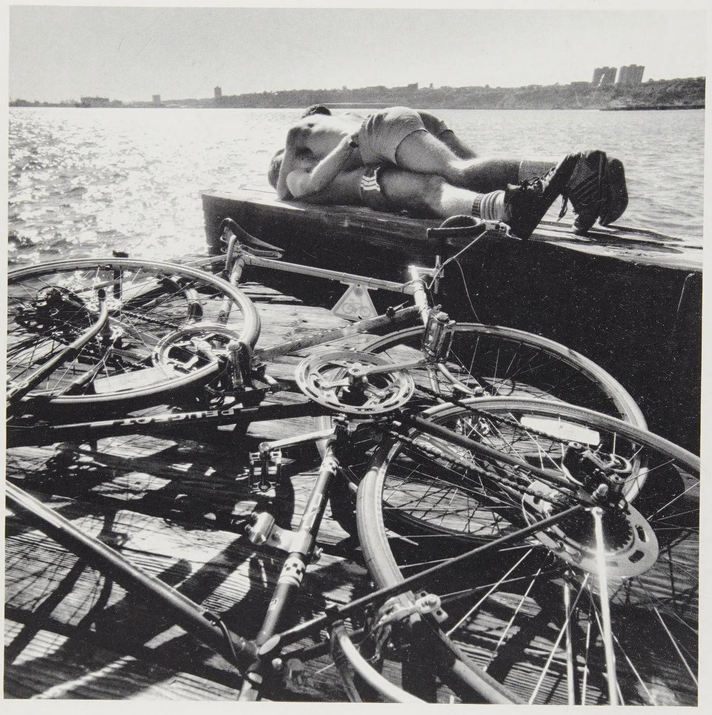
By contrast, the male nudes by Tress in Facing Up are playful, fun, imaginative and still retain their eroticism without relying on vulgarity to shock a viewer. I get a sense of humor behind the photographs that dulls the edgy seriousness of the skill that it took to pose the models and shoot them. The intimacy between the eye behind the camera and subject feels natural.

Arthur Tress, Facing Up.


Arthur Tress, Facing Up.

Arthur Tress, Facing Up.

The photos in this book were shot in the late 1970s. Tress lived on the west side of Manhattan near the abandoned Christopher Street Piers along the Hudson River that have since became infamous in gay history before the AIDS epidemic. The piers were a place where gay men would nude sun bathe, cruise for sex, do drugs, and engage in prostitution among other elicit activities. Among those ruins, artists such as Peter Hujar and David Wojnarowicz would create  their art and find inspiration. It was Tress who introduced Wojnarowicz to the piers. Not in this book, but of note is that Tress also photographed in the cruising grounds of The Rambles in Central Park in the more secretive era of the mid 1960s.

Arthur Tress, Facing Up.


Arthur Tress, Facing Up.

This photograph titled Band-aid Fantasy taken in 1977 is my favorite from the book. There is a tenderness about this photo and the peeling away of the band-aid from the bare leg. There is sexiness too with the long legs of the two males exposed from the short shorts sitting alone together on the stairwell. As with all great photographs it is also an excellent manipulation of light and shadow. Arthur Tress, Facing Up.
 

Facing Up was first published in 1980 and again in 2004. If you can find a copy then grab it. Out of his long career and the accolades that he has received, it appears that his photos of gay life have been the least exhibited and the least appreciated. His photos of gay life deserve more recognition.  Stanford University does host an online collection of seventy of his photographs, including some of the nudes from Facing Up, here titled Gay Fantasies.


There is a recent documentary that has  been made about Arthur Tress titled Arthur Tress: Water's Edge.   Unfortunately, it does not appear to be widely available and I have not seen it.


Further reading about Arthur Tress: an excellent, lengthy interview with him from 1999.


Sunday, February 2, 2025

Falling From The Stars


When I first heard the music of Nick Drake twenty something years ago, I did not know what he looked like so I did not know he was beautiful, nor did I know that he committed suicide in 1974 at a young age or that he was from a posh upbringing in the English countryside or that he was severely mentally ill. I simply liked the music that I was introduced to through his album Five Leaves Left from 1969. I liked his soft, fragile voice singing the introspective lyrics he had written over his phenomenal guitar playing and the string arrangements. 

Nick Drake in 1969 at the beginning of his music career.

When I was ready, I listened to his next album, Bryter Layter from 1971, and what a surprise it held as if he had matured and taken on a more jazz and rock influenced style. The songwriting was solid and slightly more humorous with self effacement. Bryter Layter became my favorite album of his and by then I knew enough about him to know that he was tall with a deep dimple in his chin, had shy eyes, a goofy smile that was not seen enough and was a beautiful man. I also knew about his death. 

Nick Drake in 1971. In two years Nick was a different person.

He was largely unresponsive to the world during the photo shoot in 1971.


By the time I came to his third and final album released in his lifetime, Pink Moon from 1972, it was obvious from the lyrics and spare recording that something had been seriously wrong with him and that he had fallen into a terrible state in three short years. The last song on the album, From The Morning, from the moment it I first heard it until today has always sounded like goodbye. 


Nick recorded other music after Pink Moon, though he struggled to write much at all sequestered at his childhood home and had a final studio recording session in 1974 for his potential fourth album. During that session, he had declined to a degree that he was unable to sing and play at the same time. His voice and lyrics on those five songs (Black Eyed Dog, Hanging On A Star, Rider on the Wheel , Tow The Line & Voices) are that of a broken human being. There is something sad and uncomfortable that those recordings were released as they feel like exploitation of someone who was mentally ill.


After the music, I began to watch the documentaries and read the books about Nick Drake in hopes of understanding how this twenty-six year old fell from the stars so quickly. In the years since his death, it seems that many fans have placed more emphasis on his life and death instead of his music. He has been made out to be a handsome, romantic young poet that was wrongly overlooked in his time and could only be appreciated and mythologized after he had been sacrificed. The music is often secondary to the image that has been constructed around him like a brittle sarcophagus much like what has happened to Kurt Cobain. For those that wish to compare Drake to Vincent van Gogh, please seek out some decency within yourself.


Upon recently reading the 2023 biography, Nick Drake - The Life by Richard Morton Jack, did it seem a more honest portrait of him finally emerged from the misty veil of legend. Other books about Drake have only given the last three years of his life a superficial overview and neglected the details of how ill Nick Drake became at the end. Not only was he extremely ill with schizophrenia, under his parents care in the country, but his personality had become violent and destructive when he was not catatonic, running away at all hours and for days, in the hospital, getting detained by police or being erratic in every possible manner. He refused to take his medicines, was getting conflicting medical opinions, had one shock therapy treatment, was overly indulged by his well-meaning parents and he should have been sectioned as he was possibly a danger to others. He did prove to be a danger to himself when he committed suicide by swallowing sixty pills, stripping down to his underwear and laying atop his bed on November 25, 1974 to die.


Some fans and even some of his friends will quibble with the word suicide to describe what Nick did, but you do not ingest sixty pills that you know will kill you and hope to survive the same as placing the end of a barrel of a shotgun in your mouth. They suggest that because he did not leave a note that it could not be suicide, but Nick was no longer able to communicate through writing or speaking. He left his music as his final words and that is what should matter. By denying him of his last act of suicide, people contribute to the stigma of shame that people associate with it.


Another point of contention among Nick Drake fans is his sexuality and that is again discussed at points in this book. Some bristle at the suggestion that Nick was gay and claim that there is no way that he was anything but straight. Their argument is that if Nick was gay then why has no one of the same sex come forward to claim they had a tryst with him? I respond by asking, if Nick was straight then why have no women come forward after all these decades to claim they had a romantic relationship, or a one night stand with him? All that has come forward is that he had strictly platonic relationships with a couple of women, never discussed women with anyone in a sexual manner and that has been it. His life has been combed over again and again and there is equally no evidence that he was heterosexual. Perhaps, Nick did not even know what he was.


When I closed this book I realized that there was nothing to romanticize about Nick Drake or his life. He suffered in his last years and made those around him suffer too. After the countless biographies and documentaries, it is important to remember that it is best to enjoy his music as I do, but do not put him on a pedestal cast in bronze.


Nick's friend, John Martyn, recorded this song about him.


Wednesday, January 22, 2025

The White, Cold Heart of January

A snowy view from the second floor of my house. Photo by me, January 2025.

It was only supposed to be flurries here and it mostly was for over three hours, but the atmosphere was so dry that it became a high ratio snow and it gushed. At the three in the afternoon the snowfall began it was twenty-three degrees with a dewpoint of twelve and those were unusual circumstances to produce snow around here. A typical snow here is one with a high moisture content, produces big and fat flakes, is sloppy, heavy and occurs under conditions with temperatures in the low thirties and dewpoints in the upper twenties to low thirties. Yesterday, the conditions were different with an Arctic airmass in place and the snow was dry and productive. It has been a few years since a snow of this type occurred here and when it does, it creates havoc with quick accumulations that land on roadways turning them quickly into sheets of hard ice.

Photo by me, January 2025.

Photo by me, January 2025.

The storm's arrival at rush hour stranded people on the untreated roads over the hilly terrain of this area. Cars unable to climb these icy hills  were abandoned and if people were close enough to home they walked the remainder of the way. I observed many stunned and bone chilled cold people on foot coming up my hill from the river on a road that has no sidewalks, but plenty of curves.


If you are a native to northern Georgia, like I am, then you will remember the similar scenario that occurred on January 12, 1982 and it was called SnowJam! I was a couple of months shy of turning nine, but that was a fun storm as a kid and a horror show for adults. In some ways, it is reassuring to think that as much as life has changed in those forty-three years, that we Georgians make getting stuck in the snow a memorable adventure.

Photo by me, January 2025.

Photo by me, January 2025.
 

This was a minor snow here, amounting to an inch, that was a big headache for some. So far this winter, there have been five inches of snow here and within a short period of only eleven days between two storms in the white, cold heart of January. This is above average and compared to the two previous winters there was no snow, not even a flurry.


The cold has been exceptional too. This morning it was eleven degrees here and three degrees above zero in the mountain valley town of Blairsville. The U.S. Forest service stations at Cohutta dropped to six degrees and the one at Brasstown (not to be confused with the state's highest peak, Brasstown Bald) achieved four degrees. The temperature was below freezing here from 6PM Sunday to 1PM Wednesday for a total of sixty-seven straight hours. We reached a high this afternoon of thirty-four for only a couple of hours.

The U.S. snow depth map for January 22, 2025. Courtesy NOAA.

Aside from the cold, the most impressive aspect from a regional perspective was the record breaking snow from the southern tip of Texas, along the Gulf Coast and South Atlantic Coast. For most in the coastal areas this truly was a once in a lifetime storm and in some places it was record shattering.

Today's visible satellite imagery showing the snowfall through southern Alabama, northern Florida, Georgia and South Carolina.

New Orleans received over nine inches breaking a record from 1963 by seven inches.

Mobile, Alabama saw eight inches.

Snow meets beach on the Florida Gulf Coast.

Pensacola Beach, Florida had seven and a half inches.

The small southwest Georgia town of Camilla accumulated eight inches.

Milton, Florida broke the state record for the most snow ever with 8.8 inches.

Savannah reported three inches of snow, but I suspect most of it was probably sleet.

This was a rare storm in that areas further to the south saw more snow than areas of the region to the north. Atlanta's record was not so impressive as it snows there more often than the other places listed. Atlanta broke the daily record  for January 21st from 1983 with 1.1 inches. I was ten at the time and do not have any particular memories of that snow, which was probably more where I lived in the northwest part of the state. We may have called that SnowJam 83! as every snowstorm after 1982 for several years was called SnowJam!


Friday, January 17, 2025

The Reunion Project

Photo by me, January 2025.


Just after six in the morning last Friday, the snow poured and kept at it for hours. It was a beautiful snow, wet and heavy coating the landscape in thick white frosting. When the snow tapered off as a period of freezing rain, there was four inches.


Photo by me, January 2025.

Photo by me, January 2025.

Photo by me, January 2025.

It was the most snow we have had in a few years and the greatest storm of the two we have had at this house since purchasing it. The snow lingered on the ground until Monday and by that time I was ready for it to be gone. Snow excites me less the older I get as if my lifelong romance with it has melted. I hope this is the only significant snow this winter.

Photo by me, January 2025.

Living on a winding road on a hill above a river there was no possibility of getting out on Friday. By Saturday a plow cleared the road and it was safe to get out the during the day before the refreeze of the slush by nightfall. In Monroe, Georgia, where there was less snow than where I live, I found a snowman outside a church.

*

This month I began writing the first draft of my fourth novel. It is a story independent of my four previous books, meaning it has nothing to do with my life, though of course it draws from my experiences. The folder on my desktop where I store my writing is labeled The Reunion Project, so I will call it that until enough of the story is written and the real title comes to me. As much as I would like to write a novel about Atlanta punks in the 80s, this book is set in the present day. The present is too interesting to neglect. At this stage, I have no idea of how long it will take me to write this novel.


Information Society, Walking Away (late 1988)

Tuesday, December 31, 2024

Time Is A Wild River


There was no meeting with an old lover in a grocery store as a piano softly played and the snow did not turn to rain in 2024. There was the potential to meet an old lover as we were in the same county in another state. I turned an invitation over and over in my mind as I watched boats on the canals of Fort Lauderdale. I crossed the Everglades, still turning it over when I stopped in his county. I withheld the invitation and neither did we happen upon each other through a chance encounter. The arbitrary boundaries on the map that compressed us into the same few square miles were not strong enough to force a meeting.

Dan Fogelberg's song is nice enough, but as much as songs may sometimes underline our reality, they do not create it.


I did speak with an old lover a few times this year. I wanted his side, his recollections and then after he read an advance copy of Shadow's Gravity, I wanted his opinion. Had I gotten enough right about us? His verdict was that I had in the condensed space there was for him. He said I made him sound too beautiful, but he was and still is. He invited me to meet him on a levee again, to watch the sky, talk about the future and spar over George Michael. He vowed not to slap me the next go-around. I rubbed my cheek and I chided him that I had not drowned.


There were deaths among my family and I saw some relatives who I had not seen in too long of a time. Life is filled with gaps and silences as much as we may say we are busy filling that time with the noise of everyday living.


My favorite moments this year were meeting my great nephew a few times and watching my nephew get married. I am not much of an advice giver, but I wished him good luck.


I loafed, gardened, finished writing the end of the Aviary Hill Series, read other writers, listened to music new and old, swam in the ocean (too far out as per usual), hiked and walked more miles than I could ever write about.

Carter campaign memorabilia on display at the Carter Center in Atlanta. Photos by me, March 2016.

Goodbye, President Jimmy Carter. Thank you to him for helping to preserve the Chattahoochee River.


At the end of this year, I kept asking myself where the time had gone, not just 2024 but all of my fifty-one years. I reflected and remembered what I wrote in Dweller On The Boundary: time is a wild river like one I swam in as a boy or watched beside the Indian mounds. Time is downstream from where I type this and it does not matter. The world keeps on spinning.


My favorite new song of 2024 was And Nothing is Forever from the Cure's 2024 album.


My favorite new to me old song for 2024 is Cars and Explosions (1979) by a long ago Atlanta band called The Fans.


I saw so few new films this year and that is unusual for me. My favorite among the limited selection was Sebastian.